Archive

Archive for the ‘Iran’ Category

Twenty Years of al-Salafiyya-al-Jihadiyya

February 26th, 2013 No comments
Although the U.S. has been in conflict with Salafi-jihadism for twenty years now, American policy can often feel stuck in 'Argo.' ©1999 Derek Henry Flood

A billboard of Ayatollah Ruhollah Khomeini on the outskirts of Tehran. Although the U.S. has been in outright conflict with Salafi-jihadism for twenty years now beginning with the 1993 bombing of the World Trade Center which involved Khalid Sheikh Muhammed, American policy can often feel stuck in ‘Argo’ in its relentless pursuit of a post-Shah, Shia-ruled Iran and its proxies. Iran is governed by principle peculiar to modern Shi’ism known as velayat-e-faqih, “the guardianship of the jurist” which is a complete anathema to Sunnism’s al-Salafiyya-al-Jihadiyya doctrine. ©1999 Derek Henry Flood

New York- It’s been twenty long years since Eyad Ismail, Ramzi Yousef and co drove that Ford Econoline Ryder rental van through the Holland Tunnel from Jersey City and parked a massive urea urea nitrate bomb in the parking garage of the North Tower of the World Trade Center. Today was a quiet anniversary of an event largely forlorn in America’s national collective conscience in the shadow of the much more dramatic 9/11 attacks.

That wintry day two decades ago, the United States faced the beginning of a poorly outlined struggle against the decentralized doctrinal ideology of al-Salafiyya-al-Jihadiyya [Salafi-jihad]-a form of Islamism that articulates violent means to achieve political gains.

One of the points about the Sunni jihadi attack on New York in the winter of 1993 is that it marked an unexpected pivot from the perceived threat of highly centralized millenarian Shia revolutionaries and resistance terrorism epitomized by the rise of the clerical regime in Iran in 1979 and the formation of Hezbollah in Lebanon in 1982.

This suited America’s so-called ‘moderate’ Sunni or Sunni-dominated allied nation-states just fine. These regimes could be free to espouse anything from the export of the Wahhabiyya strain of Salafism that serves at the state theology in Saudi Arabia and Qatar to the Marxist-tinged radical Arab socialism emblematic of the Hizb-al-Ba’ath (Ba’ath Party) or the post-Nasserist-turned-personality cult regimes of Egypt and the Maghreb. That was of course until these ideas either collided with American foreign policy as in the case of Iraq or collapsed under their own weight as in the case of Tunisia.

A friend who was stationed for the U.S. State Department in Saudi Arabia’s Eastern Province-where the 1996 Khobar Towers bombing took place-and later Bahrain, privately hinted to me this view of the Shia threat had changed little at least in some official channels even while the U.S. was propping up a succession of Shia prime ministers in its Iraq project and its Special Forces had fought alongside Shia irregulars to oust the Taliban in northern Afghanistan.

But while the United States has done a great deal to degrade Ba’athism by invading Iraq in both 1991 and 2003 and aiding Syrian rebels bent on demolishing the Ba’ath in Syria at present, for instance, American foreign policy still remains fixated on Iran and Hezbollah and would still not dare challenge the vitriolic Wahhabism prevalent in the Arabian Peninsula. Though it is a fool’s errand to pit absolutist wings of Islam’s great schism against one another for purely hypothetical purposes, it has been transnational Salafism that has attacked the American homeland in 1993 and 2001 and in East Africa in 1998 and Yemen in 2000. If the two fronts of radical Islamism were simplistically made analogous to the space race, Khomeini may have successfully launched Sputnik first, but it was bin Laden who put a man on the moon.

We should be reminded that the 1993 attack was connected to 9/11 through the common thread of Khalid Sheikh Muhammed (KSM as he came to be referred to in intelligence jargon-inflected reporting) who is currently in the pre-trial hearing phase of the never ending, apparently never closing saga at the sweltering detention facility at Guantánamo Bay, Cuba.

Though Yousef and the other 1993 plotters were not known to be formally pledged members of a then fairly embryonic al-Qaeda, they certainly were connected to the Peshawar-based jihadi nexus borne out of the CIA and Saudi funded anti-Soviet jihad that took place west of the Durand Line. The radicalization of the Masjid al-Farooq in Brooklyn and its refugee center-cum-Office of Services set-up visited by Abdullah Azzam was a definite factor in the 1993 plot. While the trial of the five accused al-Qaeda men in Cuba (KSM, Walid bin Attash, Ramzi bin al-Shibh, Ammar al-Baluchi, and Mustafa Ahmad al-Hawsawi) is referred to by the United States government as a “9/11 trial” In sense, it dates back the events of 1992-1993 in Brooklyn and Jersey CIty involving the men linked to KSM and the original plot against New York City.

Though there are conflicts about some of the precise specifics, one of Omar Abdel Rahman’s sons, Mohammed Omar Abdel-Rahman was nabbed (by the CIA, the Pakistanis or a mix of the two) in Quetta, Pakistan around the time of KSM’s apprehension when Pakistani authorities were hunting KSM. Mohammed Omar Abdel-Rahman is now a free man back at home in Egypt after having been listed as one of the CIA’s “ghost prisoners” (as was KSM) in 2005. He was released by the Mubarak regime in 2010.

KSM was apprehended in Rawalpindi, Pakistan ten years ago (though alternate sources may say he was actually captured in Quetta a month prior and the news of his arrest delayed by Pakistani authorities). His and four other co-conspirators’ painfully deliberating preliminary hearings has been described as being in “discord.” From what information does come out of the proceedings, it has partly the air of a circus what with Walid bin Attash (a.k.a. Khallad) making multiple outbursts about violations of attorney-client privilege and his defense lawyer wrapped in “a black abaya out of respect to the religious sensibilities of her client” according to a Guardian report.

The Miami Herald’s Carol Rosenberg describes the awkward goings on at Guantánamo as primarily focused on the ways in which the five suspects were captured and the conditions under which they were detained before being exfiltrated from “black sites” to the American naval base on Cuba’s southeastern coast. In other words, these proceedings are not about 9/11 .

A shop selling a model of the original World Trade Center's Twin Towers. ©2013 Derek Henry Flood

A tourist shop just dozens of meters from the site of the former World Trade Center selling a model of the original Twin Towers. ©2013 Derek Henry Flood

OLYMPUS DIGITAL CAMERA

Half a world away from the shop in New York City, a similar shop near the base of Petronas Towers in Kuala Lumpur, Malaysia selling metal models of Southeast Asia’s twin towers. ©2010 Derek Henry Flood

Mali, North Korea and the Confluence of Histories

February 2nd, 2013 No comments
A protestor marching on Benghazi’s corniche on March 9, 2011 defaces as 1 dinar note featuring Muammar Qaddafi to shown his disdain for the Libyan dictator at the height of the Arab Spring movement. ©2012 Derek Henry Flood

A protestor marching on Benghazi’s corniche on March 9, 2011 defaces as 1 dinar note featuring Muammar Qaddafi to shown his disdain for the Libyan dictator at the height of the Arab Spring movement. This image to me epitomizes the concept of my article featured below. ©2012 Derek Henry Flood

New York- I had a couple of long term projects published at the end of this past week. The first was an examination of the little known history conjoining Mali in West Africa with North Korea in Northeast Asia over at Asia Times Online. I discovered this newly built part of Bamako while riding around on my fixer’s motorcycle last year when we were trying to organize a semi-doomed trip toward the front line with MUAJO et co up in Mopti Region.

Screen shot 2013-02-02 at 8.14.31 PMThis spot I found (linked, left) in the Malian capital is called Carré des Armées (Army Square) and it was built by a North Korean state enterprise (not as if Pyongyang encourages private enterprise). As I begun to play with the idea of doing a full length article on the topic, it dawned on me that Mali and North Korea had a shared history dating all the way back to Mali’s independence from France in 1960.

Not exactly a topic for broad mass consumption, I know, but for those who it may interest, I think it’s a fascinating topic. It also speaks to a lesser understood phenomena of how ties forged in the heat of the Cold War still can very much exist in a post-Cold War world.

The ties between North Korea and Mali certainly may have lessened over the decades and have changed in their orientation (started out as political and military in the 1960s, now more transparently financial-the same goes for Mali’s relationship with China). One of the key differences between the relationships between North Korea and China with an inherently unstable state like Mali is that seemingly no circumstances would or will derail ‘business as usual.’

Just for argument’s sake, I honestly think that if Ansar Eddine and its Salafi allies had somehow managed to capture Bamako and miraculously gain some kind of political legitimacy that over time Beijing and Pyongyang would still send delegations back to Mali to get their business interests on track. After all in 1960, the government of Modibo Keita was deemed a righteous, radical enough anti-imperialist government by Kim Il-sung and co to forge ties on the other side of the world. Maybe the anti-imperial tenets preached in the context of  Salafiyya-jihadiyya would be revolutionary enough for the Beijing’s politburo and the DPRK’s Workers’ Party of Korea to be able to keep infrastructure projects going uninterrupted. Who’s to say….

The second was a passion project nearly 14 years in the making about the history and symbology of all the war zone/quixotic regime currencies have managed to collect in my travels over the years featured in The Christian Science Monitor. It spans from an out-of-circulation Iranian rial I obtained in Tehran in 1999 to a Libyan 1 dinar note I saved from Benghazi in 2011.

The depiction of Philip the Arab on Syria’s 100 pound note is an indicator of the deep historical ties between ancient Iran and Syria. In a rock carving at the Naqsh-e Rustam necropolis in southern Iran’s Fars Province, Philip the Arab is shown along with the Roman Emperor Valerian the Elder as they bow before the Persian king Shapur I the Great. ©1999 Derek Henry Flood

The depiction of Philip the Arab on Syria’s 100-pound note is an indicator of the deep historical ties between ancient Iran and Syria. In a rock carving at the Naqsh-e Rustam necropolis in southern Iran’s Fars Province, Philip the Arab (kneeling, far left) is shown along with the Roman Emperor Valerian the Elder (center) as they bow before the Persian king Shapur I the Great (mounted). Damascus’s employing Philip the Arab is likely no accident. Unlike the Saddam-era old 25-dinar note in Iraq depicting the Battle of al-Qadissyah showing an ancient Arab (Iraqi) enmity toward Persia (Iran)–Hafez’s al-Assad’s mortal enemy in the inter-Ba’ath rivalry–Syria’s 100-pound bill emphasized Syria and Iran’s ancient, shared history…in which Roman Arabia (present day Syria) is the supplicant. ©1999 Derek Henry Flood

Not a project that even the most ambitious young turk with a fancy master’s degree fresh out of Georgetown or Columbia could have done. It’s a bit of a blood, sweat and tears project in that sense and I was thrilled to have it come to fruition. I’ve dealt with countless fast talking money changers, sky rocketing wartime inflation, crossed borders only opened when regimes were in the process of being toppled and made all sorts of other absurd, laborious entreaties to obtain this collection.

Many of these specimens were lost for years or so I thought, until I uncovered them last fall in a musty storage locker and began to examine them one by one. I then realized they merited an article treatment on their own.

Most of these notes (except the Qadaffi-era dinar which is still in circulation pending the release of new notes by Libya’s central bank) are long out of circulation. And more importantly, each banknote tells a story both in its iconography laden artistry and in the circumstances in which I obtained it. The 20th anniversary of the Shia Islamic revolution in Iran, the post-9/11 war in Afghanistan, the Anglo-American invasion of Iraq, and so forth.Screen shot 2013-02-02 at 8.18.11 PM                                                                                                                                                                       

Iran like it was 1999

December 30th, 2012 No comments
DHFlood_Esfahan

Shops in Naqsh-e Jahan Square in Esfahan, August 1999. ©1999 Derek Henry Flood

New York- In the summer of 1999 I embarked on an ambitious backpacking trip attempting to travel from London to Lahore entirely overland/water. The second to last leg of this rambling adventure was securing a visa for the Islamic Republic of Iran, the preferred exonym of the country’s post-1979 clerical revolutionary rulers. I anxiously applied for a transit visa (a tourist visa would’ve been much harder to come by at the time) at the Iranian embassy in Ankara and was gruffly informed the process could take as long as several weeks-which seemed like an eternity at that age.

In the interim I travelled extensively around southeastern Turkey/Kurdistan, skirting along the Syrian, Iraqi, Iranian, Azeri, and Armenian borderlands. I was just scratching the surface of both Eurasia’s utterly complex, divisive histories and my interest in photography. For I wanted not to be a photojournalist showing the world bursting at the seems, but a photographer using gorgeous imagery composed of diverse human and physical geography that emphasized man’s commonalities.

If I had envisioned myself as a war correspondent then I would have gotten myself into Kosovo that summer, rather than giving the Balkan conflict a very wide berth in circumambulating through the Italian peninsula when traveling from Budapest to Athens. To me at the time, wars were transitory events and historical epochs seemed eternal.

After 15 days of traveling through vast swaths of Turkey completely devoid of the hordes of ANZAC backpackers frolicking in Istanbul and its party-all-the-time West on the notorious Fez Bus circuit, I was finally granted an Iranian visa. But with my fall university semester quickly on the horizon back out in San Diego and having already traveled to Doğubeyazıt on the Turkey-Iran border, I had to fly to Tehran’s Mehrabad Airport in order to save time and have enough days to travel through nearly all of Pakistan afterward and return to California in time to sign up for that fall’s classes.

Arriving in Tehran, I then embarked on a massive road tour via the country’s bus network that would eventually have me riding in a Balochi smuggler’s Toyota Hi-lux truck to the Mirjaveh/Taftan border and crossing a mind-blowing civilizational boundary separating the Iranian plateau from South Asia on foot. There are richer elements to this story but I am leaving them in my long form, as yet unpublished book project. I stumbled on these photos while working on another project and felt like throwing up a few images to remind myself of this hopeful time period if nothing else.

DHFlood_Shiraz_sunset

The sun sets behind the hills of Shiraz, in southern Iran’s Fars Province. I would do anything to retreat back to this era where everything still seemed possible. A Dialogue Among Civilizations had a much nicer ring to it than a Global War on Terror. ©1999 Derek Henry Flood

A man peers into the void of the now destroyed Arg-e-Bam (Citadel of Bam) after having observed the total solar eclipse on August 11, 1999. ©1999 Derek Henry Flood

A man peers into the void of the now destroyed Arg-e-Bam (Citadel of Bam) after having observed the total solar eclipse when the diameter of the Moon completely obscured that of the Sun in broad daylight on August 11, 1999. The Citadel was later leveled in the Boxing Day earthquake of December 26, 2003. ©1999 Derek Henry Flood

Another shot of the magnificent mud brick Citadel following the eclipse. Notice the sky is still slightly dark. ©1999 Derek Henry Flood

Another shot of the magnificent mud brick Citadel following the eclipse. Notice the sky is still slightly dark. ©1999 Derek Henry Flood

The Safavid-era Imam mosque in Esfahan's Naghsh-i Jahan Square. Brilliant azure skies. ©1999 Derek Henry Flood

The Safavid-era Imam mosque in Esfahan’s Naghsh-i Jahan Square. Brilliant azure skies. ©1999 Derek Henry Flood

What non-political pictorial on Iran would be complete without an image of the storied Persepolis? A chador-cloaked woman saunters through to ruined columns of the ancient Achaemenid capital in Fars Province.   The über decadent party held here by Shah Reza Pahlavi in October 1971 to celebrate Cyrus the Great's founding of the Persian monarchy 2500 years previously is thought by some have been one of the initial sparks of the Shah's undoing. The SAVAK-supervised four-day event rankled a then relatively obscure ayatollah exiled in Najaf, Iraq named Ruhollah Khomeini who was infuriated by the whole affair. ©1999 Derek Henry Flood

What pictorial on Iran would be complete without an image of the storied Persepolis? A chador-cloaked woman saunters through to ruined columns of the ancient Achaemenid capital in Fars Province. The über decadent party held here by Shah Reza Pahlavi in October 1971 to celebrate Cyrus the Great’s founding of the Persian monarchy 2500 years previously is thought by some to have been one of the initial sparks of the Shah’s undoing. The SAVAK-supervised four-day event rankled a then relatively obscure ayatollah exiled in Najaf, Iraq named Ruhollah Khomeini who was infuriated by the whole affair. ©1999 Derek Henry Flood

I arrived in Iran just 10 years after Khomeini's mass funeral and his clichéd glowering visage was everywhere. Whereas in California such public space would be adorned with images aimed a crass consumer society, in Iran, a white beard who barely smiled extolled the virtues of sacrifice and martyrdom within the bounds of his own sculpted Shia context. ©1999 Derek Henry Floo

I arrived in Iran just 10 years after Khomeini’s mass funeral and his clichéd glowering visage was everywhere. Whereas in California such public space would be adorned with images aimed a crass consumer society, in Iran, a white beard who barely smiled extolled the virtues of sacrifice and martyrdom within the bounds of his own sculpted millenarian Shia context. ©1999 Derek Henry Flood

A group of boys jubilantly pose in the courtyard of  Khomeini's elaborate mausoleum set within the Behesht-e Zahra cemetery complex. ©1999 Derek Henry Flood

A group of boys jubilantly pose in the courtyard of Khomeini’s elaborate mausoleum set within the Behesht-e Zahra cemetery complex. These random kids are all adults now and could have ended up anywhere from foot soldiers in the IRGC to members of the dissident Green Movement or anywhere in between.  ©1999 Derek Henry Flood

Categories: Iran, Turkey Tags: , , , ,

A Decade of War and Peace

August 20th, 2012 No comments


Barcelona- Partly out of boredom and partly out of the itch to simply create something new out of old, I threw together this photo montage over the weekend. In this era of digital photography where one shoots thousands of frames rather than analog hundreds, I was reflecting on how almost all of the images I make will never see the light of day in this regard. I put this video together in a largely random fashion with images that have been just sitting in my laptop for years. I put the photos in the order they came to me as I grabbed them one by one from various folders containing my view of many of the biggest news events of the last 10 years.

Interspersed with them are much more sublime moments of everyday life around the world. An elephant in Thailand, an aged priest in Ethiopia, a glitzy office tower in Manhattan. This has been my reality and is our collective reality. Globalization and social networking simultaneously accelerate worldwide travel and technological integration while hyper compartmentalizing our lives. We speak more so to only those who we want to and listen to those with whom we already agree.

Dr. Abdullah Abdullah preparing to depart for Ghazni province with the Afghan airforce to campaign in remote ethnic Hazara villages. Abdullah was the leading opposition candidate challenging President Hamid Karzai in the August 2009 elections. On the right stands a Shi’ite Seyyid accompanying him to Shia population centers for campaign credibility. ©2009 Derek Henry Flood

No one knows just where any of this is going. Billionaire fraudsters suddenly imprisoned, social revolutions springing up from seemingly nowhere (though not quite), calcified dictatorships counted on for decades in the interests of “stability” suddenly crumbling to pieces, it seems as if the entire world order is in question.

No grand conspiracy here, just plain, old awful war. On August 15, 2006, a Lebanese ambulance lay destroyed by what appeared to be an Israeli missile strike (quite possibly a drone strike or SPIKE anti-tank missile) outside of Sidon in southern Lebanon, an irrefutable violation of the Geneva Conventions on war crimes. Pro-Likud right-wing bloggers would dare say scenes like these were part of elaborate false flag operations by Hezbollah or photoshop masterpieces by left-wing or pro-Hezbollah journalists meant to demonize the Israel Defense Forces. This ambulance was not part of the so-called “ambulance controversy” nor am I aware that this particular wreckage appeared anywhere in the international media at the time.  ©2006 Derek Henry Flood

The Kalashnikov

The Marxist-imbued Mozambican flag bearing the Kalashnikov rifle. Source: Wikipedia

New York- The Avtomat Kalashnikova assault rifle, known popularly as the AK-47 or Kalashnikov, became one of the defining symbols of Third World national liberation movements and a physical manifestation of anti-imperialist thought in the second half of the twentieth century. The Kalashnikov appears most notably Frente de Libertação de Moçambique (FRELIMO)-designed flag of Mozambique pictured above. Hezbollah has a Kalashnikov-like weapon pictured on its yellow and green flag as a symbol of its persistent resistance to Israeli occupation and military hegemony. During the ‘summer war’ in July and August of 2006, the Ba’athist regime in Syria, one of the Shia group’s principal external state backers, had Hezbollah’s yellow banners flying up and down its Mediterranean coast to drum up Syrian domestic support as well as that of visiting GCC tourists. Syria’s cities were plastered with these what should be incongruous visuals that summer. Anyone who covers the developing world’s violent conflicts is likely intimately and awkwardly familiar with the Kalashnikov’s wood and metal sinews coupled with that unmistakable banana clip.

Wild jumble of Hezbollah and Ba'athist propaganda posters in Latakia, Syria on July 29, 2006. Note the visage of Imam Hussein to the left mixing in Shia religiosity. I find the central image of particular interest with Hezbollah Secretary-General Seyyid Hassan Nasrallah hoisting the aforementioned rifle of ambiguous provenance over his head. The image seems to suggest that if it came down to it, Nasrallah himself would pick up a gun and join the fight. ©2006 Derek Henry Flood

An NTC rebel fighter loads a clip into his Kalashnikov near al-Aghela, Libya on March 4, 2011. ©2011 Derek Henry Flood

An FSA rebel fighter points his Kalashnikov toward the frontline in Ain al-Baida, Syria on January 29, 2012. ©2012 Derek Henry Flood

A pair of Jamiat-e-Islami Afghanistan (Northern Alliance) fighters tote their Kalashnikovs at a position at Ai Khanoum, Afghanistan at sunset on November 6, 2001. ©2001 Derek Henry Flood

An Afghan National Police officer brandishes a Hungarian AMD-65 rifle (an AKM variant) while patrolling a bazaar in Kabul during Afghanistan's 2009 presidential elections. ©2009 Derek Henry Flood

On June 27, 2010, a sandal-clad Kyrgyz soldier inspects vehicles at a checkpoint in Osh, Kyrgyrzstan during that country's constitutional referendum vote on the devolution of presidential power in the wake of deadly inter-ethnic conflict in the Ferghana Valley earlier that month. ©2010 Derek Henry Flood

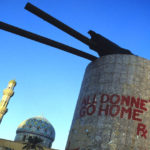
In going through old photo portfolios this week I discovered an image I’d nearly forgotten I’d taken of a massive Soviet-style Kalashnikov monument on the road in central Iran. I love the photo not for its artistic merit obviously but for what it symbolizes. I tweeted the photo to C.J. Chivers, author of the definitive Kalashnikov book, The Gun.  In return he created a kind blog post featuring my snapshot which I’ve reposted below.

Screen grab from C.J. Chivers The Gun blog on my Iran photo. This monument appears to me to a fascinating mix of millenarian Iranian Shi'ism and Marxist realist public art. Stylistically the sculpture appears appears quite disjointed as if it was either created by more than one artist or was adapted or recycled from a previous monument. ©1999 Derek Henry Flood

The Fabled City

On 11 August, 1999, I photographed a total solar eclipse from the Arg-e-Bam (Citiadel of Bam) in southeastern Iran's Kerman Province. On 26 December, 2003 the citadel was largely destroyed in a calamitous earthquake which killed almost 27,000 people, nearly a third of the city's inhabitants. ©1999 Derek Henry Flood

New York- In sorting through some old belongings today I found a couple of now ancient-seeming portfolios which I went to a lot of trouble to make at the tail end of the portfolio era. In what turned out to be fruitless, expensive exercises in futility I spent countless hours (not to mention loads of money on ink and specialty papers) printing attempts at gorgeous images. I scanned some of the images and decided to show them here on this blog. Though these images may appear, and perhaps are, somewhat random, they were part of my earliest project concept which I titled “The Fabled City.” I envisioned it as grassroots, multimedia education project to enlighten denizens of American cities about the complex civilizational crossroads where South Asia, Central Asia, and the Iranian Plateau intersect.

The ultimate goal of the project was to then inform the public about the people and socio-cultural history of Afghanistan working past the entrenched framework of Afghanistan clichés as a “buffer state,” “failed state,” or worst of all, “the graveyard of empires.” Could you imagine if a coterie of overeducated policy wonks and far removed armchair historians constantly referred to the country you call home as some sort of “graveyard?” Or in the case of Pakistan, “the world’s most dangerous place?” Or Iran being “evil” in some way?  Though all of these terms are or were meant to have a purely geopolitical resonance (in theory), it is a short jump to the demonization of a culture particularly when punditry is then mixed with geographic distance.

Following the solar eclipse pictured above, a group of Afghan men depart the adobe Bam complex, the world's largest mud brick structure. Today this spectacular site lay in ruins. ©1999 Derek Henry Flood

I had an idea-somewhat indicative of the era-to do a guerrilla-style wheatpaste poster campaign in the manner of a 1990s New York City street artists like Cost and Revs (who have long since faded into relative obscurity). I thought I could bring awareness to this region-much of which had been cutoff the the outside world since 1979-by starting a one man grassroots poster campaign. I was gearing up to embark upon this idea just as 9/11 shook this city. My plan to photograph Taliban-ruled Afghanistan (ie the Islamic Emirate) after the winter snows thawed in the spring of 2002 morphed into doing war photography in the Islamic State of Afghanistan among the United Islamic Front for the Salvation of Afghanistan (ie the Northern Alliance) some six-months ahead of schedule. I still clung to this idea well into the 9/11 wars.

At the height of the war in Takhar Province in early November 2001 I managed to visit the broken columns of the heavily looted Graeco-Bactrian city of Ai Khanoum overlooking the Panj River dividing Afghanistan and Tajikistan. In Iraq in May 2003 I climbed the humongous, spiraled minaret of Malwiya in Samarra before things turned ugly in that country’s nihilistic fitna and anti-occupation war. The minaret was later attacked by insurgents in 2005 after American soldiers carelessly used the ancient monument as a lookout post. From the top of the Abbasid calpihate-era Malwiya, I gazed at the magnificent al-Askari shrine housing the bodies of the 10th and 11th Twelver Shi’ite imams, its gilded cupola shining brilliantly under the Iraqi sun. The sacred al-Askari dome was later demolished by Sunni sectarian fighters in February 2006 and its minarets were destroyed by them in June 2007.

I was digging around in a musty closet and unearthed these decade-old prints which I then hastily scanned in a consumer Epson flatbed scanner. I don’t have much use for these rather benign, old prints now. Maybe I will finally paste them up around the Brooklyn or Queens waterfront as I intended to do exactly a decade ago. The Fabled City was crushed in the collapse of the Twin Towers. Unending war and terror would come to rule the day rather than the elements of architectural elegance and sophisticated history I had hoped to use as tools to foment a better day.

The Arg-e-Karim Khan at night in Shiraz, Iran. Note the incredible tile work on the tower. ©1999 Derek Henry Flood

The Abassi mosque complex in southern Punjab Province's Cholistan Desert outside Bahalwalpur, Pakistan. Under the blistering desert sun, the local men had me stand on a marble slab in the geometric center of this courtyard that was inexplicably cool even at high noon. ©2000 Derek Henry Flood

The reflecting pool in front of the tomb of Jalaluddin Surkh-Posh Bukhari at the Uch Sharif complex outside Bahalwalpur, Pakistan. Bukhari was a prominent Sufi evangelist and is revered as a saint by regional practitioners today. As his name denotes, he originated from Bukhara in what is now present day Uzbekistan. This place to me represented the idea of Central Asia and South Asia being part of one cultural and religious continuum. Here the facade of the Fabled City rises into the sky. ©2000 Derek Henry Flood

Lost and Found

February 1st, 2012 No comments

Antakya- Doing some googling to see where some of my recent Syria work might have ended up, I stumbled upon some references to my work from close to a year ago that I missed in the chaos of the time. I put them on my blog in part to create a living catalogue of my work so that I can keep track of it (and possibly add it to my CV). On March 1 of last year while I was in the Libya war, my colleague Chris Zambelis had an article in the March 2011 edition of the CTC SentinelThe Factors Behind the Rebellion in Iranian Kurdistan” (endnote #8). I was also cited by colleague Peter Lee at Asia Times Online on April 9, 2011 in “China under pressure over Saudi rise.” Love to find these little nuggets after the fact.

It’s a Hazy Shade of Winter on the Syrian Border

January 27th, 2012 No comments

The gloomy Orontes River flowing through downtown Antakya. You can feel the dampness from this image. ©2012 Derek Henry Flood

Antakya- I have an article out in today’s edition of Asia Times Online on my view from a rain soaked Hatay Province of events just over the border in a besieged Syria. It’s been raining here nonstop since my arrival, which I’m told is the norm at this time of year. It’s cold and damp. I unknowingly checked into an Alawi-owned hotel in the center of town. As soon as I arrived I met with a brilliant and incredibly friendly translator who warned me of Assad’s spies in the city and the perceived allegiance of their co-religionists here on the Turkish side of the border. The Alawis of the hotel would surely notify the local Syrian mukhabarat stationed here, the translator told me. They would be alerted to my presence upon arrival. This was apparently accepted as the norm in Antakya. When my sources showed up for an interview in my room, their first comments was, “you had to check into an Alawi hotel?” They laughed and I made a self-depracating comment about being a naive Westerner who would never have guessed where I was staying would be an issue.

It’s always an awkward juxtaposition to be in such a vibrant, relatively healthy community when next door to a hot war where shells are falling. I’m sitting in limbo in my hotel, which I must say is fantastic for the price ($39 USD a night for a king size bed and great wifi).  I wait patiently for a contact to call me for a lead into the next story. I duck into a hallway to get out of the constant deluge. He tells me of danger ahead. A zone where journos aren’t collaterals but rather the targets of snipers and tank operators. I must tread with caution. I tell him I’ve been to Libya and was nearly hit by a Qaddafist sniper last summer. I don’t want a repeat of the same. Or do I?

Here’s the reality of the journo mindset. When everyone was kept out of Syria and that was simply accepted as the status quo, there was no issue. But as soon as one person gets deep into Homs behind the lines with the Free Syrian Army or talks about freely walking around the liberated town of Zabadani, that raises the bar for everyone. It is a furious momentum that builds around a set of extremely driven, competitive, often brilliant people where one’s feet can float off of firm ground drunk on the false notion of invincibility. It is all a farce. Yet it goes on. None of the bogus justifications or rationales in the world can make sense of dying in another man’s war.

When I noticed on Twitter that the New Yorker’s Jon Lee Anderson (whom I met in Libya a few times) was inside Homs, and I’m sitting, twiddling my thumbs in Turkey, it gave me that feeling. Of course Jon Lee made it inside Syria. He wouldn’t accept anything less than being on the first tier of a story. A guy like him doesn’t waste his time on the periphery. He goes for the jugular of the action, the beating heart of the story.

I can perfectly picture the journo hotel in Damascus. Blackberrys abuzzing, people staring at their MacBooks pretending not to notice one another, nervous freelancers networking amongst A-listers. Then again, I always see myself as an outsider never fully wanting to be on the inside. It is as if I am stuck in the mindset of the D.C. hardcore scene circa 1981 and I never want to sell out. Just a Minor Threat. I remember seeing Tim Hetherington outside the hospital in Ajdabiya about a month before he was killed in Misrata.  Jon Lee was there. Everyone who was left in Libya seemed to have turned up that day. I stood in the morgue silently looking at horrific casualties. I was warned by a group of edgy fighters at the western gate not to dare return the following day or there would be severe consequences. The following day a group of journos were grabbed out of their vehicles by Qaddafists. I was in a cramped minivan making the 14-hour trek back to Alexandria with a Libyan family lucky enough to have the money to go to Cairo.

The Republic of Hatay's Majlis (Meclis in Turkish-parliament) now houses a trendy cafe and regional cultural center overlooking the Orontes and downtown Antakya. The short lived republic existed from September 7, 1938 to June 29, 1939. ©2012 Derek Henry Flood

To try and get in becomes a nearly irresistible urge. I fight a battle between the lusts of my lucid imagination and my more over the horizon goal of living as long as possible. There is only so long I can people watch non-hijabed gorgeous Alawi or Alevi or whatever Westernized looking Occidental girls strut by in the cold rain from the open air juice bar or çorba (soup) stand. I joked with my translator friend that there are probably more girls in Turkish-Kurdish areas of Germany rocking hijab than those in downtown Antakya. The mix of ethnicities and sects here makes for a colorful human cast. Yesterday after hearing the fajr azan (the morning call to prayer), for the first time I’ve ever noticed in Turkey (save for possibly once in Trabzon a decade ago), I heard church bells ring out. For a moment in time it feels like a paradise of fierce torrents until I remember that there are Soviet-era Syrian tanks facing Turkey not so far away at all.

There is a war nearby with a gravitational pull. You can tell yourself, “just one more harb (war), one more thawra (revolution), and then I’ll quit.” I’m not forcing myself to be here. Hell, I love it here. It’s damn exciting to be crass about it. Throughout the ummah, everything seems to take place in the shadows, within the whispers. And that, to be frank, is part of the draw. A world of public denial, a culture of the unspoken. Sex, drugs, war, it’s all available from Morocco to Mindanao. A quick phone call, a short text message, a soft knock on a hotel door. Here in this lovely rump province of French Mandate Syria, the Sajak of Alexandretta, I somehow feel at home. In fact, there is no place I would rather be at the moment.

One of the best facets of Turkish life: the food. Kasarli Pide (Turkish "pizza") in the foreground. a feast fit for a sultan in the city of Adana after a long trip from Queens. ©2012 Derek Henry Flood