Archive

Archive for the ‘Russia’ Category

TWD Chechnya/North Caucasus Reading List

April 29th, 2013 No comments
A Turkish-language poster of the late Chechen rebel leader Aslan Maskhadov. ©2002 Derek Henry Flood

A Turkish-language poster of the late Chechen rebel leader Aslan Maskhadov. The poster reads “Chechen Republic of Ichkeria State Leader” with “Noxçijcö” in the center being the endonym of “Chechnya”as transliterated into Turkish. This term is surrounding  a wolf which is the animal symbol of the Chechen people favored by nationalist separatists. I photographed this poster in a school in the village of Duisi, Georgia south of the Chechen border along the Alazani river. ©2002 Derek Henry Flood

New York- In the two weeks since the tragic double bombing of the Boston marathon with improvised explosive devices, the media has fixated on the ethnic and religious background of the Tsarnaev brothers of Cambridge, Massachusetts. Though various mass casualty attacked have been carried out in the United States in the past year, media outlets did not fixate on whether James Eagan Holmes, who killed 12 people in Aurora, Colorado or Adam Lanza, who killed 26 people in Newtown, Connecticut were Protestants or Catholics nor what their precise ostensibly ethnic European backgrounds were.  But the fact that Tamarlan and Dzhokhar Tsarnaev were ethnic Chechens and [I would think Sufi] Muslims while also not being native-born Americans has become an obsession of U.S. national media which has almost no knowledge of the history nor present dynamics of the North Caucasus region of which Chechnya is a central part.

In the wake of the Boston attacks and with the Sochi Winter Olympic Games just 10 months away and the insurgency’s western most fringe not far with just 250 kilometers (155 miles) drive separating Sochi and Nalchik, it may behoove some of the ultra ambitious yet very young D.C. jihadi wonks or overnight area experts in the Dupont Circle-Think Tank Row (Massachusetts Avenue) zone to read up on some of this stuff before inadvertently advancing an FSB narrative on the North Caucasus.

With so many people suddenly thrust in writing about a region with which they appear to have only the faintest familiarity (judging by for instance referring to Dagestan as “Russia” rather than as a constituent republic of the Russian Federation), it struck me that a minimal reading list might be useful.

This is by no means meant to be a comprehensive list but more of books in my collection the influenced me into the intrigue that is the Caucasus region. A longer list would have to begin with Anatol Lieven’s Chechnya: Tombstone of Russian Power which was published only months before the start of the second war in 1999 or say Thomas de Waal and Carolotta Gall’s Chechnya: Calamity in the Caucasus all the way to Emma Gilligan’s Terror in Chechnya: Russia and the Tragedy of Civilians in War.

Here is my very short Chechnya/North Caucasus reading list in no particular order as drawn from my personal library:


1. A Dirty War-A Russian Reporter in Chechnya by Anna Politkovskaya

I stumbled upon an autographed copy of the incredible book in New York’s legendary strand bookstore not long after returning to the U.S. from covering the Afghanistan war in the fall of 2001. With a classic James Nachtwey cover photo catching my eye in the book stacks, I quickly became enthralled with the story of Chechnya forever. Part of the reason I went to the first D.C. conference I ever attended was because Ms. Politkovskaya was slated to be a speaker. Disappointed she wasn’t actually there, all day throughout the conference I wondered what happened to her.

Finally a very frustrated audience member shouted out that she didn’t come to Washington because she had been threatened by the Kremlin that were she to speak about war crimes in Chechnya to [an anti-Kremlin] D.C. crowd, she would not be allowed to return to Russia (she was a dual Russian/American citizen). She was then killed by a “control shot” less than three years later while entering her Moscow apartment building.

My autographed copy of the English translation of Anna Politkovskaya's A Dirty War from 2001.

My autographed copy of the English translation of Anna Politkovskaya’s A Dirty War from 2001.

2. The Chechen Wars-Will Russia Go the Way of the Soviet Union? by Matthew Evangelista

This analysis of the first Chechen war (December 1994-August 1996) and the early stages of the second war beginning in the fall of 1999 discusses the role (or lack thereof) of international law in the Chechen conflict and what it meant for the future of democratization in the Russian Federation. Done from an in-depth sociological angle, Evangelista examines the broader problems inherent to Russian federalism when faced with ethnic and regional nationalisms in places other than Chechnya such as Tatarstan, Bashkortostan and even Sakhalin island facing the Sea of Okhotsk. A fascinating read.

3. Open Wound-Chechnya 1994 to 2003 by Stanley Greene

Nearly all of the books in my collection on Chechnya have covers and are illustrated by black and white photography. The Chechen wars were perhaps the last great era of black and white photojournalism before the American intervention in Afghanistan after 9/11 heralded in the mainstreaming of digital photography writ large. The defining photography book of both Chechen war is Open Wound by Stanley Greene by Trolley Books of London. As a fellow photographer, I cannot recommend this stunning, chilling book highly enough.

Stanley Greene's photo of Chechen rebel President Dzhokhar Dudaev. Dudaev was assasinated while talking on a satellite phone on April 21, 1996. To Daudaev's right is rebel Vice-President Zeilmkhan Yanderbiyev. Yanderbiyev succeeded Dudaev as president and was later assassinated in Doha, Qatar on February 13, 2004

Stanley Greene’s photo of Chechen rebel President Dzhokhar Dudaev  in Grozny in February 1994. Dudaev was assasinated while talking on a satellite phone on April 21, 1996. To Daudaev’s right is rebel Vice-President Zeilmkhan Yanderbiyev. Yanderbiyev succeeded Dudaev as president and was later assassinated in Doha, Qatar on February 13, 2004.

4. Chechnya Diary: A War Correspondent’s Story of Surviving the War in Chechnya by Thomas Goltz

This book by veteran Caucasus correspondent Goltz is centered around in the notorious Samashki massacre that took place in April 1995 near Chechnya’s eastern border with Ingushetia. Goltz’s book, a sort of sequel-at least in title anyway-to his earlier Azerbaijan Diary, is a real journo’s type of book. It contrasts the viciousness of war and it attendant crimes with the banal egotism and tiresome logistical challenges of getting a tough story out of a deadly environment.

5. The Man Who Tried to Save the World: The Dangerous Life and Mysterious Disappearance of an American Hero by Scott Anderson

My current read about the disappearance of The Open Society Institute’s Fred Cuny who was on his way to Bamut, Chechnya in February 1995 and was never seen again. With a stark cover photo diptych by the above mentioned Stanley Greene, this book reads like a fictious thriller save for the scary fact that it is real.

6. A Small Corner of Hell-Dispatches from Chechnya by Anna Politkovskaya

Politkovskaya’s 2003 follow up to a A Dirty War with a dramatic cover photo by Dutch photojournalist Eddy van Wessel. Hard to read but of course well worth it.

7, To Catch a Tartar: Notes from the Caucasus by Chris Bird

A memoir of the chaos taking place in the post-Soviet Transcaucasus of the 1990s by a former AFP and AP Tbilisi-based correspondent with cover photos by my colleague Thomas Dworzak.  This book focuses not solely on the first Russo-Chechen war but also on the tumult in Georgia and even a bit on Abkhazia-which are essential to understanding the overall situation in the greater Caucasus region today.

8. Caucasus: Mountain Men and Holy Wars by Nicholas Griffin

Griffin’s book explore the legacy of the legendary ethnic-Avari anti-colonial warrior Imam Shamil from a sector of Avaristan in what is now Dagestan. Griffin writes about the difficult sectarian and communal history of the Caucasus ending with the rise of the late Shamil Basaev, named after the 19th century Sunni Avari resistance leader.

9. Allah’s Mountains-The Battle for Chechnya by Sebastian Smith

Smith, an AFP correspondent during the first Chechen war and later IWPR analyst in Tbilisi, profiles Russia’s geopolitical enfant terrible that is the Caucasus. All in all, a complex, fantastic read.

9. Chienne de Guerre: A Woman Reporter Behind the Lines of the War in Chechnya by Anne Nivat

Nivat’s recollection of 6 months spent behind the lines after sneaking in Chechnya from neighboring Ingushetia during Putin’s re-invasion of the rebellious independence-minded republic. Nivat’s book highlights the importance of refusing to follow rules imposed on modern journalists by both authoritarian and democratic states (think of the French military impeding journalists in northern Mali at present). A decade ago, Nivat very astutely put the hopelessness of the conflict in a passionate context in an excellent NPR interview.

Viewing Syria Through the Chechen Prism

December 11th, 2012 No comments

Syria, then. ©2002 Derek Henry Flood

New York- I have a piece in today’s edition of Asia Times Online about Russia, Chechnya and the Russian view of Syria. Russia, like it’s red-headed authoritarian stepchild China, constantly asserts an inviolable concept known as “national sovereignty” which is essentially a brutal policy used to suppress ethnic questions within present day borders.

Being schooled in the West, it is easy to believe that an empires had two distinct traits that defined them: they began with death defying, deep sea voyages that emanated from western and northern Europe and that after the immense devastation European societies incurred during the second world war, they had no choice but to abandon their colonies in Africa and Asia whose upkeep and administration was no longer viable as Europe’s shattered nation-states were forced to turn inward in order to rebuild themselves from the ground up.

Beginning with the Netherlands’s withdrawal from Indonesia in 1949 and Britain’s exit from Libya in 1951 and largely ending (at least in a formal sense) with the collapse of the recalcitrant Portuguese empire in 1975, Europe’s last remaining maritime colonial power, Americans and other Westerners have been under the impression that the Age of Empire is a dusty relic of a best forgotten time period that long predated the political correctness revolution that began in the early 1990s.

But what this unfortunate view of history largely obscures though is that broader Eurasia today remains a continent of present-day land-based empires who have very much yet to embrace “the end of history” as it were. Russia’s never-ending struggles to contain ethnic rebellion in the Caucasus and even ensure that a restless Republic of Tatarstan remains in the Kremlin’s fold and a China still very much wrestling with the Tibet question while trying to turn Xinjiang Province into some sort of a living cultural museum run by ethnic-Han migrants, indicates that the still subjugated populations in these regions often view Moscow and Beijing as colonial powers in the post-modern Oriental sense of things.

So sure, at points you will have people abroad advocating for human rights in these places in order to serve an anti-authoritarian agenda but the post-war Western powers with their own unaccounted for, sordid history of collective rape and colonization, combined with half-hearted diplomacy that is doomed to fail from the start and hampered by both conservative isolationists and anti-imperialists at home, means that there are no worthwhile mechanisms for resolving these conflicts.

So in essence, Chechnya and Tibet, Tatarstan and East Turkestan can have no realistic hope of achieving an independent statehood because the very IDEA that they are presently under the yoke of empire has been suppressed. When the British Foreign Office issues weak kneed statements like ”Tibet is part of China. Full stop” and when President Bill Clinton characterized the then ongoing ethnocide in Chechnya as an “internal affair” for the Russians alone to resolve, Whitehall, the White House and others abet expansionist authoritarianism with Eurasian characteristics.

Russia, and to a somewhat lesser extent China, have extended this hardened concept of non-interventionism to the unwilling inhabitants of Syria. Today, we the world have let the ancient, stunning city of Aleppo be transformed into another Grozny. When will it stop?

To Catch an Unattainable Tatar

February 16th, 2011 No comments

New York- So the Lotus revolution has come and gone (sort of ) and the story has moved on to the more mundane and TWD has to comment on more important matters, namely the new cover model of the Sports Illustrated Swimsuit Issue. Irina Shayk is described to the American reader in a typically dumbed down fashion as ‘Russian’ but having what appeared to be an Arabic-to-Russian-to-English transliterated last name I doubted very much she was ‘Russian’ in the way ethnic nationalities are defined in Russia. In the Soviet era and in post-Soviet successor states today like, say, Kyrgyzstan, your ‘nationality’ (what Americans term ethnicity) is written in your passport and is ascribed to you by the state. Cultural diversity in post-Stalinist in Eurasia is not a concept dreamed up by left-leaning American university professors in the early 1990s blindly promoting multiculturalism but part of an oppressive system aimed at repressing the populace.

I assume her name was shortened by a modeling agency or talent scout early on in her career to enhance her marketability. Likewise, it probably wouldn’t be prudent to promote her Muslim background in light of what happened when certain pundits got ahold of the fact that Miss USA, Rima Fakih, was, gasp, an Arab and a Muslim.

Upon a quick gander of Irina’s Wikipedia page, as I suspected, her actual last name is Shaykhlislamova which is a Russified-version of the Arabic ‘Sheikh al-Islam’ (‘Scholar of Islam’), nothing vaguely non-Islamic about that last name. She says that her father is a Tatar (though she grew up in the Chelyabinsk Oblast on the border of Kazakhstan, to the east of Tatarstan) which is a Turkic Muslim ethno-religious group that inhabits the present day Tatarstan inside the Russian Federation in the Volga region. After the dissolution of the Soviet  Union, when the Russian Soviet Socialist Republic was transforming into what would become today’s Russian Federation, it sent out a Federation treaty in the spring on 1992 to be signed and ratified by its 89 internal republics and regions: two republics refused; Chechnya and Tatarstan. While Chechnya spiraled into a violent rebellion that destroyed most of the nation and continues to this day, Tatarstan fell into line a couple of years later and flourishes today with its capital of Kazan having become one of Russia’s best destinations for investment thanks in part to its oil reserves.

So there you have it, Sports Illustrated has its first (nominally) Muslim cover girl. Hooray for progress!!! It’s time to throw the clash of civilization into the ash heap of history and move forward with over-simplified bikini diplomacy! The Kremlin currently demonizes Muslim women in the Russian Federation as so-called ‘Black Widows’ but a bombshell named Irina can help explode that myth. Wishful thinking on my part…

A (Very) Dirty War

October 15th, 2010 No comments

My autographed copy of the English translation of Anna Politkovskaya's A Dirty War from 2001.

New York- I was looking through some boxes of old dusty books today and came across my now most treasured copy of A Dirty War: A Russian Reporter in Chechnya by Anna Politkovskaya. Anna was killed by a so-called “control shot” in the elevator of her Moscow apartment building on October 7, 2006; the assassin still unknown. Her killing has been unsolved for over four years now and likely never will be. It is the Russian Federation after all. Many years ago now, I stumbled upon a semi-rare copy of her paperback book from England in the stacks of the Strand bookstore here in New York. I hurriedly went up to the register to pay for it knowing it was a score. Then when I went to leaf through it on the subway I noticed it was autographed. In December of 2003, I attended a conference on Chechnya in D.C. where she was supposed to speak. I disappointedly noticed she never arrived. An ally of hers, an American professor then stood up and announced to the audience that she had been notified by a crony of Vladimir Putin that if she traveled to Washington and spoke out against the atrocities of the second Russo-Chechen war, which she had every right to do as an American citizen (she was an ethnic Ukrainian born in New York holding US citizenship, the child of Soviet diplomat parents), she would be barred from returning to Russia. I have no way of ever knowing if that was exactly the case but I have no reason to doubt it either. Damn.

A Dirty War is one of the most serious books on the subject out there. Her second book A Small Corner of Hell: Dispatches from Chechnya is hard to read. I’m not sure if I ever quite finished it. I still haven’t brought myself to read any of her posthumously published works. Вы все еще пропустили Анна… (на украинском языке: Ви все ще пропустили Ганна)

Marsho (Маршо)

September 22nd, 2010 No comments

New York- I finally found Marsho (“Freedom” in Chechen) by director Murad Mazaev  in its entirety online. Marsho is Chechnya’s first film shot on location in Georgia’s Pankisi valley in 2002. The film is notable in that it was shot with the permission and acquiescence the late warlord Ruslan Gelayev. Gelayev essentially ran the area at the time and anything that took place there required his ok. The other person helping the production along from afar was British stage and screen legend Vanessa Redgrave. Redgrave later helped Murad take the film to festivals in Europe to showcase his work, an impassioned critique of the (still) ongoing Chechen wars. Murad made the film with Surkho Idiev who is shown playing the piano in the first scene. Murad’s costar is a half-Georgian, half-Kist actress named Mariam Kublashvili from Akhmeta. I joined Murad into this murky world in 2002. We almost got shot making a run out of the place ducking in the back of an old white Lada barreling through a Georgian checkpoint on the way out and then I was later grabbed off of a marshrutka (minibus) by the Georgian successor to the KGB. Sure, there’s lots more to tell in this story but that’ll be in the book.

For more, see Murad’s website: http://chechenfilms.org/ (in Cyrillic)

Another Katyn Tragedy

April 13th, 2010 No comments

Sun sets on New Jersey's Katyn monument as stoic local Poles gather for an evening vigil. ©2010 Derek Henry Flood

A woman is overcome with grief at the decapitation of the Polish leadership in the Katyn forest as the grim coincidence reverberates with Poles around the world. ©2010 Derek Henry Flood

New York- Many people who are not Poles or who lives outside of the western post-Soviet space were not previously aware of the Katyn forest massacre in the context of Russian-Polish relations. I myself used to know nothing about this Stalinist tragedy in the midst of the second World War until about five years ago when I happened upon a massive, dramatic bronze sculpture in Jersey City, New Jersey, directly across the Hudson River from lower Manhattan. The statue is dedicated to the Polish officer corps and soldiers who were slaughtered on orders of then NKVD (predecessor of the KGB-now FSB) Lavrentiy Beria, Stalin’s number two enforcer. Beria, a perennially cruel Mingrelian thug from Abkhazia, engineered the decimation of Poland’s military leadership. On April 10, Poland’s current president Lech Kaczynski was flying to the Smolensk Air Base in western Russia for the 70th anniversary of the massacre to honor Poland’s martyrs from April 3rd, 1940 when his plane went down in this same cursed forest. After it had been reported that all aboard were killed, I knew there would be a vigil of New Jersey and New York-area Poles at the Katyn Memorial.

©2010 Derek Henry Flood

New York-area Poles gather on the evening of April 10, 2010 at the Katyn forest massacre monument in Jersey City by sculptor Andrzej Pitynski after the death of Polish president Lech Kaczynski in a plane crash in Smolensk Russia while he was en route to commemorate the 70th anniversary of the massacre of Polish soldiers by Joseph Stalin and Lavrentiy Beria.

Prisoner of the Caucasus

October 30th, 2009 No comments


The Bastara River valley, a route once used by Chechen resistance fighters and foreign terrorists to travel to the battle zone. ©2009 DHF

The Bastara River valley, a route once used by Chechen resistance fighters and foreign terrorists to travel from the Pankisi Gorge to to the battle zones of the North Caucasus. ©2009 Derek Henry Flood

Birkiani, Georgia- I returned to Georgia’s once infamous Pankisi Gorge yesterday after visiting the area seven years ago when it was hyped to be one of the most dangerous places in the world (which it sort of was). Revisiting the gorge to do fact checking for a book project was my impetus for this return trip to the Caucasus. A lot has changed since the flailing, quasi-failed state, late Shevarnadze period in 2002 when Pankisi was under the effective control of Chechen rebel commander/warlord Ruslan Gelayev (who was killed at a random checkpoint in Dagestan in early 2004).

Pankisi was once overrun by Chechen mujahideen and their Arab and Turkish epigones and was rumoured to have had the occasional spetznaz infiltration from north of the border. Pankisi was used a political football by both Moscow and Washington to advance their interests in a peripheral and weak Georgia. The BTC pipeline was more of an idea than reality at the time and the second Chechen war was still going very badly much to the consternation of Mr. Putin. Today the gorge exists as the quiet alluvial fan it once was before 1999 when Moscow came to Grozny in an attempt to demonstrate its will and refugees from Itum Kale and Shatoi poured over the mountainous border.

The refugee population has gone from somewhere in the range of 7-8000 at its height to just shy of 1000 today. The one prominent reminder of that era is the small, brick, supposedly Saudi-funded mosque in the center of Duisi. I found the house where I once stayed in the village of Birkiani which was a sort of mujahideen hostel at the time and found only a very senile, old Kist (ethnic Chechen, Georgian national) man who had no idea what I was talking about. I was taken to the region courtesy of Georgia’s Ministry of Internal Affairs in part to demonstrate once of Mikhail Saakashvilli’s early tactical successes in reintegrating this very fractured nation.

Out of place Wahabbi mosque in Duisi. ©2009 DHF

Out of place “Wahabbi” mosque in Duisi. ©2009 Derek Henry Flood

Mother and child in Birkiani village. ©2009 DHF

Mother and child in Birkiani village. ©2009 Derek Henry Flood

Young Stalin

October 29th, 2009 No comments

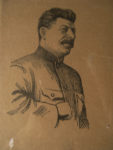
Stalin as a young revolutionary.

Stalin as a young revolutionary.

Gori, Georgia- Profile portrait of Stalin as a young Bolshevik after his arrest in the Stalin museum. This photo hangs in a museum that has not been updated since it opened thirty years ago at the twilight of the Brezhnev era. It is the B-side to the photo on the cover of Simon Sebag Montefiore’s Young Stalin. There has been a rather sizable reported uptick in revisionist pro-Stalin sentiment in Russia as of late and the BBC is reporting that this may create a small crack in Moscow’s otherwise unrepentant leadership

Does it get much more twisted kitsch than this? Stalin having a smoke and chilling with Mao.

Does it get much more twisted kitsch than this? Stalin having a smoke and chilling with Mao.