Archive

Archive for the ‘Georgia’ Category

Marsho (Маршо)

September 22nd, 2010 No comments

New York- I finally found Marsho (“Freedom” in Chechen) by director Murad Mazaev  in its entirety online. Marsho is Chechnya’s first film shot on location in Georgia’s Pankisi valley in 2002. The film is notable in that it was shot with the permission and acquiescence the late warlord Ruslan Gelayev. Gelayev essentially ran the area at the time and anything that took place there required his ok. The other person helping the production along from afar was British stage and screen legend Vanessa Redgrave. Redgrave later helped Murad take the film to festivals in Europe to showcase his work, an impassioned critique of the (still) ongoing Chechen wars. Murad made the film with Surkho Idiev who is shown playing the piano in the first scene. Murad’s costar is a half-Georgian, half-Kist actress named Mariam Kublashvili from Akhmeta. I joined Murad into this murky world in 2002. We almost got shot making a run out of the place ducking in the back of an old white Lada barreling through a Georgian checkpoint on the way out and then I was later grabbed off of a marshrutka (minibus) by the Georgian successor to the KGB. Sure, there’s lots more to tell in this story but that’ll be in the book.

For more, see Murad’s website: http://chechenfilms.org/ (in Cyrillic)

New HuffPo Piece

May 10th, 2010 No comments

Homeward Bound

November 21st, 2009 No comments

First pan-Turkey route: From West to East.

From Greece to Iraq-via Turkey: From West to East.

Abu Dhabi, UAE- Well it’s that time again. The end of the road. I’ve been going non stop for almost four months. The timeline goes something like this: Depart NYC July 30th-Arrive Abu Dhabi, Six nights at my friend Arif’s in climate controlled villa, bus to Dubai, fly Dubai to Kabul and arrive in Afghanistan on the 8th of August-Depart Kabul on the 2nd of September to Dubai, take a taxi from Dubai to Sharjah (neighboring emirate), stay one night at Sharjah youth hostel, next day fly one way to Athens, Greece, immediately take bus to Piraeus port upon landing, play brickbreaker on my Blackberry on steps of massive Greek cathedral to pass the time, then try to sleep hiding on chairs on deck of coffee shop until I get woken up by ouzo-smelling cleaning crew, take 7:15am ferry to Ios island, 10 days of whooping it up on Ios and finishing up writing from Kabul, then overnight ferry trip to Turkey via Paros and Samos (spot group of African and other assorted migrants being dragged out of the Aegean and marched to Samos’s detention center and get asked by Greek policeman not to pay attention to them),

Greek Island Zigzag.

Greek Island Zigzag.

Arrive in Kusadasi, Turkey the following morning of September, 15th, two nights there, then bus to Fethiye, 2 nights there, bus to Antalya, 4 nights there, bus to Adana, 1 night there, overnight bus to Cizre near Iraq border, cross Turkey-Iraq border on foot/taxi, Kurdish guy I’m ordered by Turkish soldier to get in taxi with gets in fisticuffs on zero line at border, take taxi from Zakho on Iraq side 3 hours to Erbil on September 25th, travel to Qandil mountains on Iraq-Iran border, cross back to Turkey on October 7th, take bus to Mardin, 2 nights there, take bus to Erzurum, 1 night there, over night bus to Turkey-Georgia border, arrive in Tbilisi following morning on October 11th, 17 days in Georgia, travel to Chechen border for book research, fly Tbilisi-Dubai, arrive Dubai on October 28th, one night at Dubai youth hostel, get another Afghan visa the next day, buy 3:30 am ticket to Kabul, arrive back in Afghanistan on October 30th, fly back to Dubai on November 9th, paid random Keralite guy at airport to drive me to Arif’s in Abu Dhabi, spent the last 2 weeks here doing the better part of nothing, flying to Dublin tomorrow, 2 nights there, then arriving back in NYC on November 24th. Phew! It’s been a long one.

Second pan-Turkey route: From South to North.

From Iraq to Georgia- via Turkey: From South to North.

Categories: Afghanistan, Georgia, Iraq, Turkey, U.A.E. Tags:

Prisoner of the Caucasus

October 30th, 2009 No comments


The Bastara River valley, a route once used by Chechen resistance fighters and foreign terrorists to travel to the battle zone. ©2009 DHF

The Bastara River valley, a route once used by Chechen resistance fighters and foreign terrorists to travel from the Pankisi Gorge to to the battle zones of the North Caucasus. ©2009 Derek Henry Flood

Birkiani, Georgia- I returned to Georgia’s once infamous Pankisi Gorge yesterday after visiting the area seven years ago when it was hyped to be one of the most dangerous places in the world (which it sort of was). Revisiting the gorge to do fact checking for a book project was my impetus for this return trip to the Caucasus. A lot has changed since the flailing, quasi-failed state, late Shevarnadze period in 2002 when Pankisi was under the effective control of Chechen rebel commander/warlord Ruslan Gelayev (who was killed at a random checkpoint in Dagestan in early 2004).

Pankisi was once overrun by Chechen mujahideen and their Arab and Turkish epigones and was rumoured to have had the occasional spetznaz infiltration from north of the border. Pankisi was used a political football by both Moscow and Washington to advance their interests in a peripheral and weak Georgia. The BTC pipeline was more of an idea than reality at the time and the second Chechen war was still going very badly much to the consternation of Mr. Putin. Today the gorge exists as the quiet alluvial fan it once was before 1999 when Moscow came to Grozny in an attempt to demonstrate its will and refugees from Itum Kale and Shatoi poured over the mountainous border.

The refugee population has gone from somewhere in the range of 7-8000 at its height to just shy of 1000 today. The one prominent reminder of that era is the small, brick, supposedly Saudi-funded mosque in the center of Duisi. I found the house where I once stayed in the village of Birkiani which was a sort of mujahideen hostel at the time and found only a very senile, old Kist (ethnic Chechen, Georgian national) man who had no idea what I was talking about. I was taken to the region courtesy of Georgia’s Ministry of Internal Affairs in part to demonstrate once of Mikhail Saakashvilli’s early tactical successes in reintegrating this very fractured nation.

Out of place Wahabbi mosque in Duisi. ©2009 DHF

Out of place “Wahabbi” mosque in Duisi. ©2009 Derek Henry Flood

Mother and child in Birkiani village. ©2009 DHF

Mother and child in Birkiani village. ©2009 Derek Henry Flood

Young Stalin

October 29th, 2009 No comments

Stalin as a young revolutionary.

Stalin as a young revolutionary.

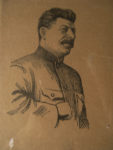
Gori, Georgia- Profile portrait of Stalin as a young Bolshevik after his arrest in the Stalin museum. This photo hangs in a museum that has not been updated since it opened thirty years ago at the twilight of the Brezhnev era. It is the B-side to the photo on the cover of Simon Sebag Montefiore’s Young Stalin. There has been a rather sizable reported uptick in revisionist pro-Stalin sentiment in Russia as of late and the BBC is reporting that this may create a small crack in Moscow’s otherwise unrepentant leadership

Does it get much more twisted kitsch than this? Stalin having a smoke and chilling with Mao.

Does it get much more twisted kitsch than this? Stalin having a smoke and chilling with Mao.

The Tbilisi Terror Museum

October 21st, 2009 No comments

Tbilisi, Georgia- I had a meeting here with the Deputy Counter Terrorism Chief from the Ministry of Internal Affairs relevant to some book research I’m doing here. My contact there showed me the cornered end of the hallway where the MIA maintains and odd but fascinating display of their accomplishments related to combatting terrorism. They even had the dud grenade that was thrown toward George Walker Bush on his visit to Tbilisi.

The passport of a long dead young Saudi shaheed who I'll assume died in vain in Chechnya as Russian cannon fodder. His Georgian visa was dated 1999 and perhaps he served in Khattab's Arab unit? ©2009 DHF

The passport of a long dead young Saudi shaheed who I'll assume died in vain in Chechnya as Russian cannon fodder. His Georgian visa was dated 1999 and perhaps he served in Khattab's Arab unit? ©2009 DHF

A nail laden suicide bomb belt on display for few to see. ©2009 DHF

A nail laden suicide bomb belt on display for few to see. ©2009 DHF

An assortment of goodies including jihadi literature in Cyrillic script, anti-personnel mines and an IED. ©2009 DHF

An assortment of goodies including jihadi literature in Cyrillic script, anti-personnel mines and an IED. ©2009 DHF

"Oranges anyone?" A homemade bomb sans detonator. Do not attempt to eat contents! ©2009 DHF

"Oranges anyone?" A homemade bomb sans detonator. Do not attempt to eat contents! ©2009 DHF

And last but not least, the Black Widow suicide bomber mannequin! ©200 DHF

And last but not least, the Black Widow suicide bomber mannequin! ©2009 DHF

Categories: Caucasus, Georgia, Russia, Uncategorized Tags:

Hollywood Comes to Gori

October 15th, 2009 No comments

Actors (who may be actual Georgian soldiers playing Russian soldiers) rumble through Gori's town square atop very loud BRTs on the set of the new Renny Harlin film. ©2009 Derek Henry Flood

Actors (who may be actual Georgian soldiers playing Russian soldiers) rumble through Gori's town square atop very loud BRTs and tanks on the set of the new Renny Harlin film. ©2009 Derek Henry Flood

Russian-made Mi-24 "Hind" gunships rattle downtown Gori on the set of the new Renny Harlin film. ©2009 Derek Henry Flood

Russian-made Mi-24 "Hind" gunships rattle downtown Gori on the set of the new Renny Harlin film. ©2009 Derek Henry Flood

Gori, Georgia- I hopped in a marshrutka (giant, ubiquitous post-Soviet sphere minibus) today in Tbilisi to make the pilgrimage to the birthplace of the original “Man of Steel” Ioseb (Georgian (which is actually Kartuli in its endonym) Dzugashvili aka Joseph Stalin (“Stalin” means Steel in Russian). I’ve become a bit of a Stalin junkie over the past few years in studying the all too relevant partitions of Central Asia, particularly the Ferghana valley, and the Caucasus which took place in the early Soviet period under little known circumstances in Moscow. I thought I would simply go have have a look at Stalin’s little glorified shack in the center of the city and get on another marshrutka back to Tbilisi. But when I got dropped off, there was a scene of burning Russian-made Georgian armor in the town square. Finnish film director Renny Harlin (who like Stalin uses a stage name-Lauri Mauritz Harjola-not that I am comparing a Hollywood director to the biggest mass murderer in history this side of Mao in any other way) has come to Georgia in what appears to be a sort of artistic mea culpa/comeback effort. Harlin is filming on location here about an American journalist and his travails in the five-day guns of August war of 2008. Usually in Hollywood, when there is a war involving Americans, there is an understood time embargo where you cannot make a movie about a war unless it is either long over or Americans are mostly over it as was the case with many of the Viet Nam films I watched as a boy in the early 1980s. But this film involves neither American soldiers nor needs to wait. The location he employed in Gori today was an actual location from last summer’s conflict which you may recall from some photos that were published last August. Once the surreal excitement was over, I walked two blocks and stumbled onto what I read had been Stalin’s extremely modest birthplace. A brick and wood shack protected by flimsy padlocks stands as Gori’s centerpiece attraction. The shack is ensconced in a Soviet-tribute temple to preserve it for all to see. It’s a bit odd for the Western visitor to behold this enormous befuddling contradiction in terms. Here was a man who killed a hell of a lot of people, many his fellow Caucasians, who is still adored by many Russians, even though he was in no way Russian (but perhaps it can be said he was Russified) and sent many Russians to their deaths. Yet Gori, this small, otherwise insignificant city in the south Caucasus, doesn’t have much going for it other than one of the twentieth century’s greatest monsters was born there and now it is sort of a politically macabre tourist attraction. Then the Kremlin, who is promoting a renewed interest in Stalin’s legacy of late, invaded and temporarily occupied it last summer for about nine days. There are almost too many contrasts to digest here.

The "Temple" of Joseph Stalin in Gori. ©2009 Derek Henry Flood

The "Temple" of Joseph Stalin in Gori. ©2009 Derek Henry Flood

I’m curious to see how the Harlin film will turn out after accidentally watching an afternoon of filming. The last film of his I can remember seeing was the comical Deep Blue Sea with a weeping LL Cool J softening up his image.

kurdistan-imgIn other developments, I had a new piece on Kurdistan and the PJAK come out in today’s edition of Asia Times which can be read here.

Has Georgia Just Slipped into Partial Irrelevance?

October 12th, 2009 No comments
Pipeline Routes Bisecting Eurasia

Pipeline Routes Bisecting Eurasia

Tbilisi, Georgia- I’ve just completed a mostly sleepless journey from Ezrurum, a dull, cold city in eastern Turkey, to the lush, rolling hills of temperate Tbilisi. At the border at 1am, I joined an already rolling bus from Trabzon and was seated next to a beautiful Armenian girl who was traveling from Istanbul to Yerevan with a few friends. I have been coming to this region since 1998 and for as long as I can remember, the border between Turkey and Armenia (whose endonym is acutally Hayastan) has been a frozen zone of Soviet-esque guard towers (on the Armenian side) since Turkey shunned its neighbor during the Karabagh war in 1993. This stunted diplomacy greatly benefitted Georgia (whose endonym is actually Sakartvelo) because Georgia acted as a trade go-between for Turks and Armenians for the last sixteen years. For products and people to reach Armenia from Turkey, they have had to transit Georgia. While Georgia itself was barely holding together much of this time with three separatist republics of its own to contend with, it acted as a sort of neutral transit corridor which helped keep the landlocked Armenian economy afloat. Armenia’s only other non-hostile border is that with a heavily sanctioned Iran. The Los Angeles-based Armenian diaspora help to keep their ethnic kin up and running while they maintained bullets battles with the Azeris and semantic and historical battles with the Turks over the events of the Great War and the dying days of the Ottoman (whose endonym is actually Osman-Ottoman is a corruption of the name Osman-the first Pasha) Empire. The ultimate geopolitical expression of this scenario was the construction of the Baku-Tbilisi-Ceyhan (BTC) oil pipeline connecting the Caspian off shore oil fields to the shores of the Mediterranean via Transcaucasia.

Both Armenia (and Iran for fairly obvious reasons) were out of the loop on the new post-Soviet energy economy. Much of Georgia’s importance for people like Senator John McCain was that Georgia was now crucial to US interests by accident of its geography. Georgia has nothing to offer in terms of resources itself particularly, but would grow to become a valued strategic client within Washington and the EU’s cooperate power structure. Mikhail Saakashvilli’s Rose Revolution with its promise of reforms and progress in a troubled democratic space was music to the West’s ears. But now as Ankara and Yerevan make a serious attempt to normalize relations, which would be a remarkable advent for peace in the region by itself, Georgia and Azerbaijan may be left out in the cold. Both nations stood by Turkey and the US, not to mention the BP-led oil consortium, and now the mood in the region may be shifting. Russia’s invasion of both sovereign Georgia and the movement of many more troops into Abkhazia and South Ossetia in August of 2008 has again altered the strategic calculus in this quintessential “Shatter Belt.” Turkey is caught somewhere in between the feigned solidarity of pan-Turkism and its ethnic-Caucasian domestic constituents.

Coming in from the Turkish border, I sat amongst  Armenians who were having to take this preposterously long, politicized bus route. I said to the girl seated next to meet as we creaked toward the Georgian capital in the wee hours of the morning that perhaps very soon this bus ride would not be such a long one not realizing that the two bitter neighbors were hours away from signing a deal in Zurich to normalize ties. If both parliaments in Turkey and Armenia ratify the new diplomatic protocols, Georgia may wake up to find itself suddenly strategically devalued by its Western sponsors making it all the more vulnerable to its northern neighbor.